


 Publications


Poster
Evaluation of a Targeted Selective Treatment Protocol based on Parity and Body Condition in Dairy Sheep in Field Conditions in France: Impact of Fecal Egg Counts and Treatment on Production
S. Jouffroy, F. Corbière, J.M. Astruc, A. Lespine, H. Karembe, P. Pinho, P. Gisbert, L. Bery, C. Rayssac, M. Abaddie, C. Delmas, K. Bourrier, M. Devaux, C. Grisez, G. Yanic, G. Bourgoin, C. Beaumelle, N. Ravinet, A. Lehebel, D. Achard, P. Jacquiet
Publication information
Word Buiatrics Congress 2026
Background and objective
When using a dewormer in a sheep flock, the concept of refugia needs to be kept in mind to postpone the appearance of anthelmintic resistance in a flock (Kenyon et al., 2009). Refugia refers in this case to gastro-intestinal nematodes (GIN) not exposed to the drug used, i.e., present in the environment or in untreated sheep. Targeted selective treatment (TST) strategies are an application of this concept. Determining which animals to treat is however a challenge, and strategies probably need to be adapted to local constraints (Hodgkinson et al., 2019). For dairy-producing small ruminants that have access to pasture, maintenance of eprinomectin (EPN) efficacy is essential for an effective management of production-limiting life-threatening GIN such as Haemonchus contortus. During the ANTHERIN project, a TST protocol using injectable eprinomectin (Eprecis®, Ceva Santé Animale, Libourne, France) was evaluated in 5 dairy sheep flocks in central and south-western France.
Materials and Methods
- Farms were included in the study based upon initial eprinomectin efficacy, enrollment in the milk yield testing program, number of ewes and habits of anthelmintic (AH) treatments.
- 2 farms bred Blond faced manech ewes in the Pyrénées Atlantiques (PA), and 3 farms bred Lacaune ewes in the Roquefort region (RR).
- Study lasted 2 (3 farms/5) or 3 years (2021/2022 – 2023).
- AH treatments were targeted by regular flock-level composite fecal egg counts (FEC).
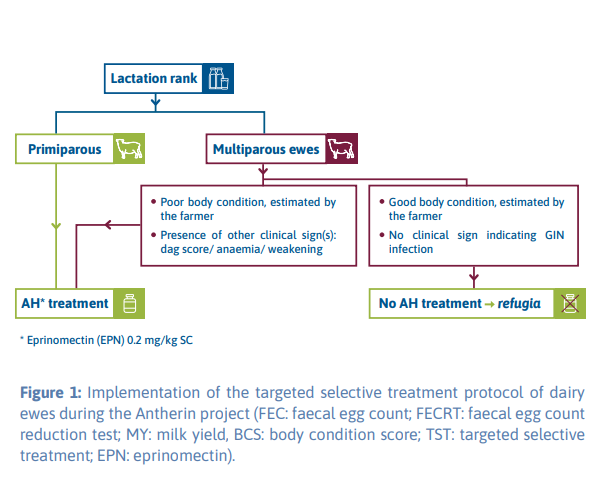
- Selective treatment of ewes was implemented using a combination of criteria, as described in figure 1. Upon treatment day, individual body condition scores (BCS) were determined and feces were collected for individual FEC and composite fecal cultures. Milk yield was collected at the end of the milking period.
- Sheep nemabiome on each farm was investigated as described by Beaumelle et al., 2024.
- Data was processed using R v. 4.1.1 in Rstudio©, either by Chi-square tests of by mixed effect models.
Results
- EPN efficacy was maintained in farms where it was initially very high (3 farms /5).
- The combination of criteria allowed for a significant reduction in GIN egg output: treated ewes had significantly higher FEC than the untreated ewes.
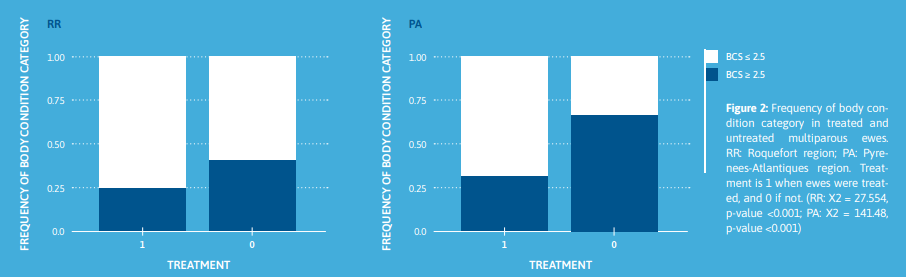
- Body condition was the main treatment criteria, and was correctly identified by farmers (figure 2).
- Other treatment criteria depended on the farm. On the only farm for which DAG score was a treatment criteria, nemabiome analysis showed Teladorsagia circumcincta and Trichostrongylus colubriformis were the main GIN present. Nemabiome analysis showed most farms (4/5) were however mainly facing Haemonchus contortus.
- 21% to 74% of lactating ewes were left untreated, depending on the farm and the year.
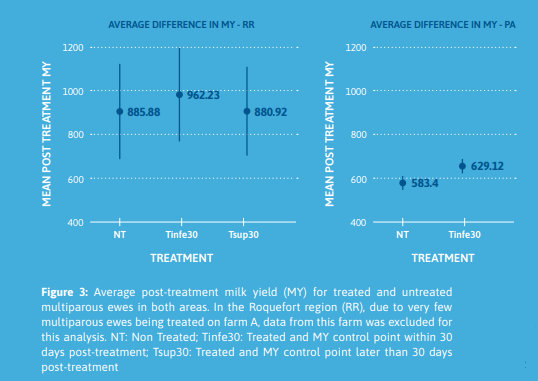
- Higher milk-producing ewes had significantly higher FEC pre-treatment in the RR. Milk response post-treatment was however not correlated to FEC in both study areas.
- Use of a targeted selective treatment: At time of mating had no impact upon ewe fertility in the PA Led to an increase in milk production of 8 to 9% in treated ewes (figure 3).
References:
BEAUMELLE, Camille, TOÏGO, Carole, PAPET, Rodolphe, et al. Cross-transmission of resistant gastrointestinal nematodes between wildlife and transhumant sheep. Peer Community Journal, 2024, vol. 4. HODGKINSON, Jane E., KAPLAN, Ray M., KENYON, Fiona, et al. Refugia and anthelmintic resistance: concepts and challenges. International Journal for Parasitology: Drugs and Drug Resistance, 2019, vol. 10, p. 51-57. KENYON, F., GREER, A. W., COLES, G. C., et al. The role of targeted selective treatments in the development of refugia-based approaches to the control of gastrointestinal nematodes of small ruminants. Veterinary parasitology, 2009, vol. 164, no 1, p. 3-1
Conclusions
- This TST protocol using a combination of simple criteria allows for a significant flock-level FEC reduction, while maintaining EPN efficacy.
- Farmers’ input in deciding which animals to treat allowed for pertinent criteria combinations per farm.
- Any production loss due to non-treatment in lactating ewes needs to be balanced with the cost of facing resistance in the short-term. In the future, criteria could be refined to better identify ewes that benefit most from treatment.
- TST should be combined with pasture management measures for increased benefits in GIN management.
Our booklet of abstracts brings together Ceva’s scientific contributions to the World Buiatrics Congress 2026.



Share this publication:


