


 Publications


Poster
Evaluation of the effect of natural prostaglandin administration postpartum on the reproductive performance of dairy cow
Riccardo Lapenta, Michele Rossetti, Giovanni Guadagni, Roberto Tramonti, Laura Menchetti, Simone Piermatteo, Alessandro Troisi, Federico Randi
Publication information
Word Buiatrics Congress 2026
Background and objective
Post-partum in dairy cows significantly affects the animal’s productive and reproductive efficiency; clinical monitoring during this phase is essential to detect and treat any reproductive tract diseases.
In the early postpartum period, the uterus of dairy cows is invaded by various bacteria, both anaerobic and facultative anaerobic, which are naturally eliminated approximately within 28 days after calving. However, occasionally, this process fails, predisposes cows to pathological conditions such as endometritis, negatively affecting subsequent reproductive performance.
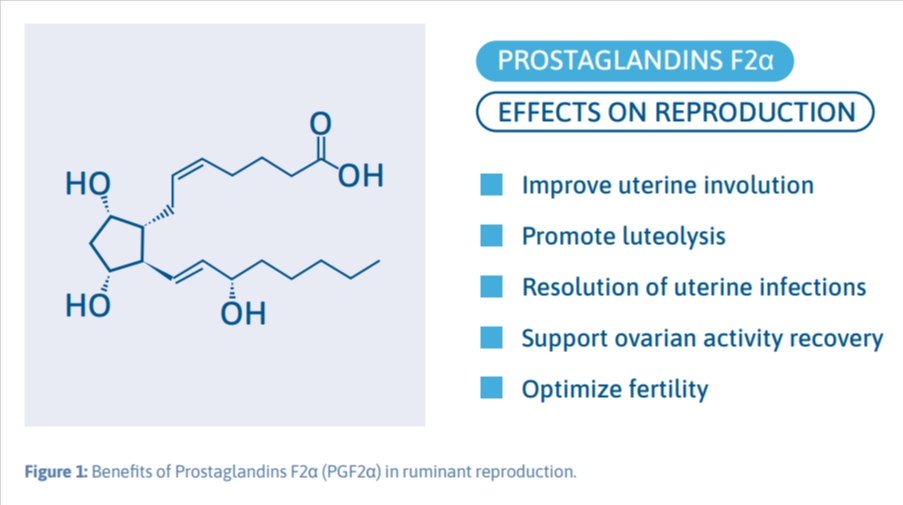
Prostaglandins F2α (PGF2α) are commonly used to improve uterine involution, promote luteolysis, contributing to the resolution of uterine infections in dairy cows, support ovarian activity recovery, and optimize fertility.
The aim of the present study was to evaluate the effects of administering natural PGF2α to dairy cows between days 8 and 14 postpartum on the immediate postpartum period and subsequent reproductive performance.
Materials and Methods
A total of 300 Italian Holstein cows were recruited and andomized into two experimental groups based on days in milk and parity (treated group and control group). Between the 8th and 14th day postpartum, the Treated group (n = 169) received an injection of natural prostaglandin (25 mg Dinoprost as Trometamol IM per subject, equivalent to 5 ml in the emitendinosus muscle, Enzaprost®, Ceva Sante Animale, France), while Control group (n = 131), received an injection of saline solution (5 ml IM per animal). All the animals were inseminated for 1st AI using Double-Ovsynch starting at 55±3 DIM.
Results
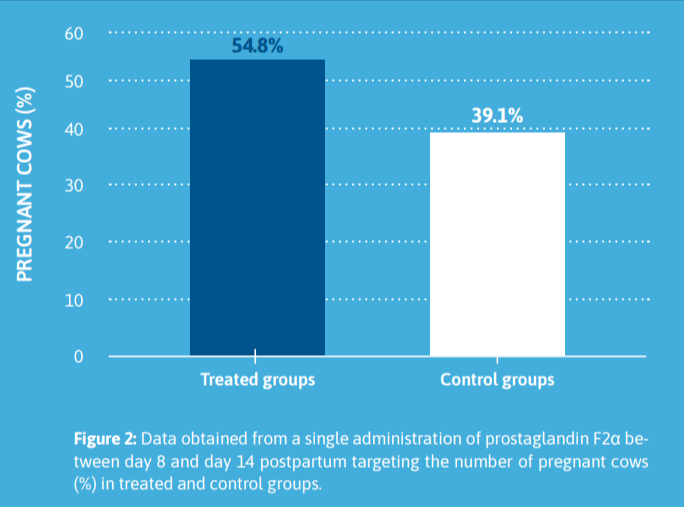
The data obtained showed that a single administration of prostaglandin F2α between day 8 and day 14 postpartum increased the CR% for 1st AI, with a higher number of pregnant cows in the treated group (54.8%) compared to the control group (39.1%) (p=0.001;OR=2.383, 95% CI: 1.420-3.998).
The administration of PGF2α had a significant impact on the probability of not exceeding 250 days in milk without pregnancy (“off cows”) (p=0.003; 94% treated, 84% control). Specifically, the percentage of “off” cows in the control group (15.4%) was more than double that of the treated group (6%).
Conclusions
The data from this study, therefore, suggest that a single administration of PGF2α, between the 8th and 14th post-partum day, may have positive effects on the reproductive performance of dairy cows. In particular, the treated group showed a higher conception rate compared with the control group, along with a concomitant reduction in days open.
Our booklet of abstracts brings together Ceva’s scientific contributions to the World Buiatrics Congress 2026.



Share this publication:


