


 Publications


Poster
Efficacy and Kinetics of an Inactivated Phase I C. burnetii Vaccine in Sheep Against various Coxiella burnetii Strains
Younes Laidoudi, Bernard Davoust, Gwenaelle Dauphin, Pedro Pinho and Philippe Gisbert
Publication information
Word Buiatrics Congress 2026
Background and objective
Coxiellosis (Q Fever), caused by Coxiella burnetii, poses a significant threat to livestock. An effective vaccine must provide broad protection against diverse field strains. This study aimed to evaluate the protective efficacy and kinetic profile of an inactivated Phase I C. burnetii vaccine (Coxevac®, Ceva Santé Animale, Libourne, France) in sheep against a panel of heterologous C. burnetii strains.
Materials and Methods
Ten ELISA-seronegative C. burnetii ewes were split into two groups of 5 animal each and vaccinated with Coxevac® on D0 and D21 according to the manufacturer’s instructions. In contrary to group 1, animals from group 2 received a new full protocol 4 months later (D141 and D162). In addition, four C. burnetii-seronegative sheep as well as three naturally infected sheep were used as control groups. Blood samples were taken on vaccinated sheep 63 days after the second injection (D84) and again on D337 which corresponds to 316 days after the end of vaccination (group 1) or 175 days after the end of the second protocol (group 2). At each time point, harvested sera from all enrolled animals were subjected to ELISA screening followed by sero-neutralization assay using a panel of 7 strains (Nine-Mile as reference and six field strains previously isolated from zoonotic human cases (n=4) or ruminants (n=2). Protection was defined as a significant reduction in infection rate (IR) compared to an unvaccinated negative control group via one-sided Mann-Whitney U tests. Kinetics were assessed using paired Wilcoxon tests.
Results
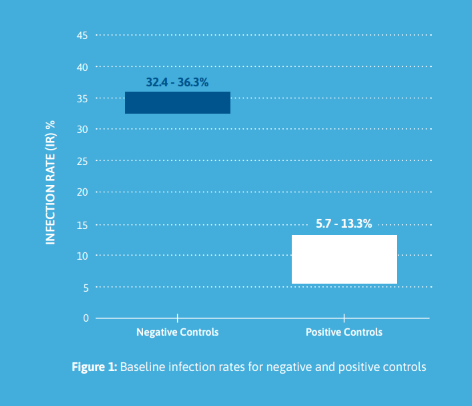
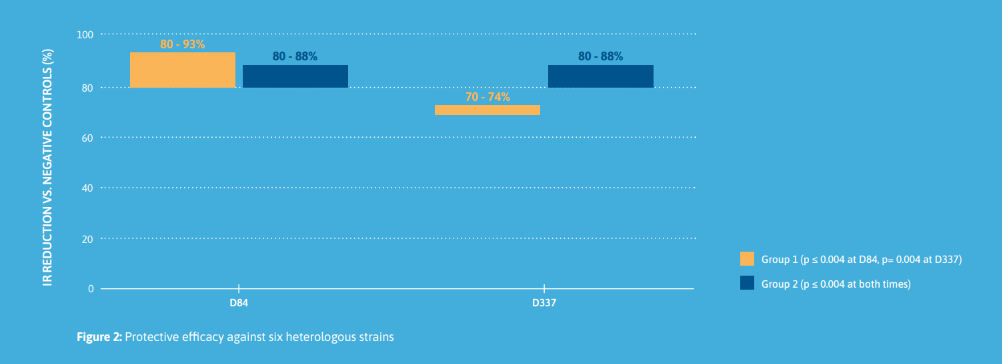
The range of infection rate was [32.4% – 36.3%] and [5.7% – 13.3%] for negative and positive controls respectively (Figure 1). Animals from the group 2 showed the most robust and sustained protection, with significant IR reductions of 80-88% against all 6 heterologous strains at both D84 and D337 (p≤0.004). The group 1 also showed strong initial protection (80-93% reduction, p≤0.004), which was maintained at D337 for all heterologous strains (70-74% reduction, p=0.004) but waned for the Nine-Mile reference strain (p=0.421, Figure 2). ELISA titers correlated with protection at early (D84) but not late timepoint.
Conclusions
Coxevac® vaccine induces potent and durable cross-neutralizing immunity against diverse heterologous field strains. Importantly, sero-neutralization can occur independently of ELISA seroconversion, highlighting the lack of sensitivity of this technique. Qualitative results of ELISA tests should therefore not be used to measure vaccine efficacy. The observed neutralization effect against various Coxiella burnetii strains suggests effective protection against these contemporary circulating isolates.
Our booklet of abstracts brings together Ceva’s scientific contributions to the World Buiatrics Congress 2026.


Share this publication:


