


 Publications


Poster
Evaluation of Immunity Duration and Booster Response to a Phase I Coxiella burnetii Vaccine in Sheep
Philippe Gisbert, Pedro Pinho, José Alfonso Abecia, Francisco Canto, Michaël Treilles
Publication information
Word Buiatrics Congress 2026
Background and objective
Q fever is a bacterial disease present throughout the world (except New Zealand). It is caused by Coxiella burnetii, a small Gram-negative, intracellular bacterium. Coxiella burnetii can infect numerous animal species and is zoonotic. Among animals, ruminants are the most affected and are the reservoir of this pathogen. An inactivated vaccine (Coxevac®) containing the Nine-Mile strain in phase I is indicated for cattle, goats and sheep. In the latter species, the duration of immunity has been established by an experimental study at 4 months. (Williams-Macdonald et al., 2023). However, in practice, farmers often only give an annual booster. This study aimed to evaluate how long immunity persists after primary vaccination and to compare the immune response from either a single booster or a repeated two-dose primary course administered six or twelve months later.
Materials and Methods
This study was approved by the Ceva Santé Animale Ethics Committee under number CFAEC-2023-18. The animal phase lasted from January 2024 to May 2025.
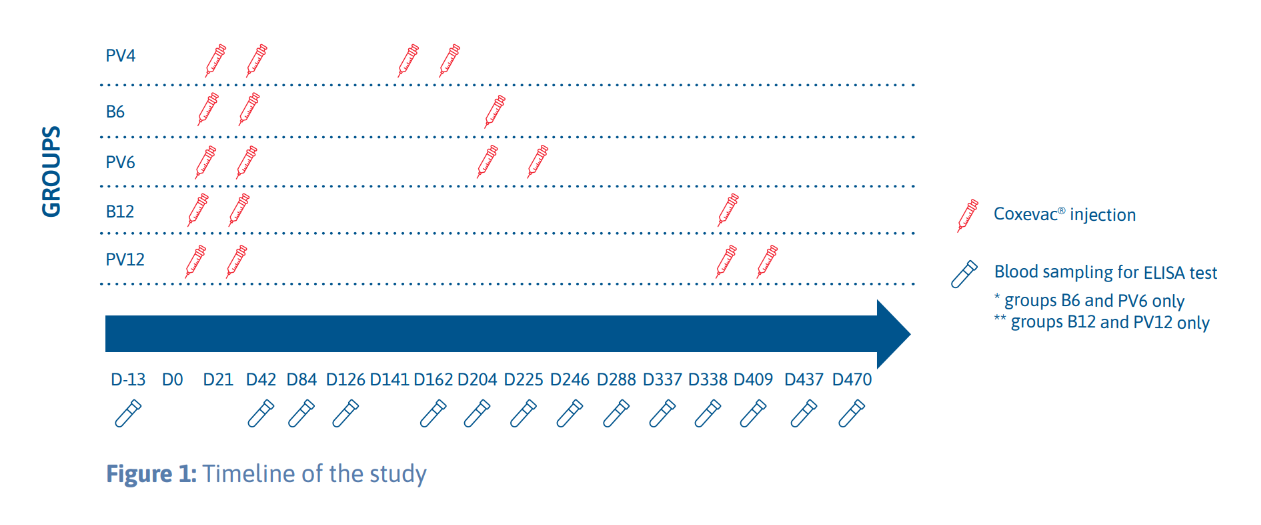
Forty-eight Coxiella burnetii seronegative ewes (ELISA analysis performed on day-13) of the experimental farm of the University of Zaragoza (Spain) were included in the study. The animals were divided into 6 groups: a non-vaccinated control group (group S; n=8) and 5 groups vaccinated with Coxevac® (Ceva Santé Animale, Libourne, France) according to the vaccine’s specifications: 2 injections of 2 mL by subcutaneous route in the neck region on D0 and D21 (n=10 per group). Then the five groups were re-vaccinated with different protocols as described below and shown on figure 1:
- Group PV4: renewal of vaccination with a complete protocol at 4 months (injections on D141 and D162)
- Group B6: booster dose injection at 6 months (D204)
- Group PV6: vaccination renewal with a complete protocol at 6 months (injections on D204 and D225)
- Group B12: booster dose at 12 months (D388)
- Group PV12: vaccination renewal with a complete protocol at 12 months (injections on D388 and D409)
Blood samples were taken at D42, D84, D126, D162, D204, D225, D246, D288, D337, D388, D409, D437, D470 to assess the humoral response to Coxiella burnetii (Figure 1). The analyses were performed by Qualyse laboratory (Champdeniers Saint Denis, France) using the commercial ID Screen® Q fever Indirect Multi-species kit (Innovative Diagnostics, Grabels, France).
Results
Data were available for 53 ewes (S: n=8; PV4: n=10, B6: n=8; PV6:n=8; B12: n=10; PV12: n=9).
All animals in the control group remained seronegative throughout the study. All vaccinated ewes showed a strong antibody response after the primary vaccination (Figure 2-6). Across groups, antibody decline varied slightly: a few animals in B6 (n=1), B12 (n=1) and PV12 (n=4) shifted to negative values before revaccination, while the majority (n=39) remained positive. Overall, primary vaccination generated robust serological responses, with only isolated cases of early waning immunity.
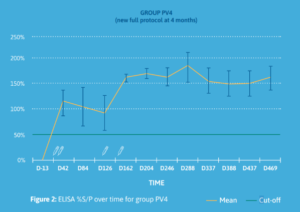
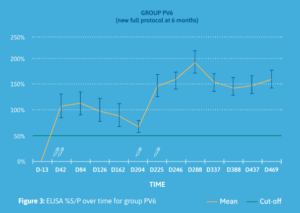
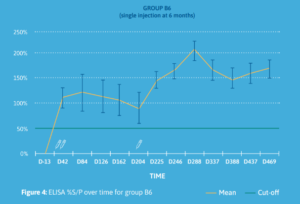
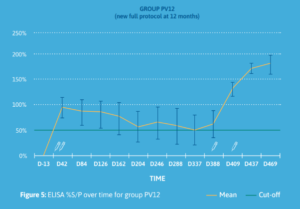
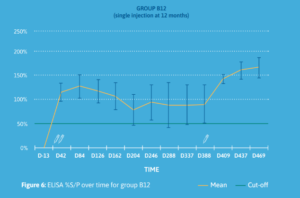
Following revaccination, whether performed at 4 (Figure 2), 6 (Figure 3 and 4), or 12 (Figure 5 and 6) months, all animals became strongly positive again and remained so until the end of the study, irrespective of the timing of revaccination or the use of a single dose or two-dose revaccination. Across all groups, antibody levels after revaccination were higher than after the initial primary course, confirming a strong anamnestic response.
References: Williams-Macdonald, S.E.; Mitchell, M.; Frew, D.; Palarea-Albaladejo, J.; Ewing, D.; Golde,W.T.; Longbottom, D.; Nisbet, A.J.; Livingstone, M.; Hamilton, C.M.; et al. Efficacy of Phase I and Phase II Coxiella burnetii Bacterin Vaccines in a Pregnant Ewe Challenge Model. Vaccines 2023, 11, 511.
Conclusions
- Based on ELISA serology results, humoral immunity following vaccination of ewes with Coxevac® is maintained for 12 months.
- When revaccinating, performing a new primary vaccination protocol does not appear to boost immunity any more than a single booster injection.
Our booklet of abstracts brings together Ceva’s scientific contributions to the World Buiatrics Congress 2026.


Share this publication:


