


 Publications


Poster
Q fever awareness among European ruminant farmers, large animal veterinarians and general practitioners
R. Guatteo, G. Valiakos, V. Dedet, A. Natale, Á. Gómez Martín, D. Cifo Arcos, J. Statham, L. Delooz, P. Vellema, S. Koźmiński, T. Wittek
Publication information
Word Buiatrics Congress 2026
Background and objective
A European Q Fever Committee was established in 2024, bringing together veterinary and medical experts from multiple disciplines and countries. A large survey was conducted among ruminant farmers, large animal veterinarians, and human medical doctors in eight European countries to assess their awareness and level of knowledge of Q fever, caused by Coxiella burnetii (coxiellosis).
Materials and Methods
The survey was carried out in 2024 by an independent opinion-polling company. The selected countries were Germany, France, Spain, Italy, the United Kingdom, Belgium, the Netherlands, and Poland. Profession-specific questionnaires were developed in English and translated into local languages. More than 900 farmers were interviewed. Eighty veterinarians were surveyed in each country, except Belgium (60) and the Netherlands (30). Fifty medical doctors were interviewed per country, except in Belgium and the Netherlands (30 each). Interviews were conducted using Computer-Assisted Telephone Interviewing technology, recorded, and lasted 20–25 minutes.
Results
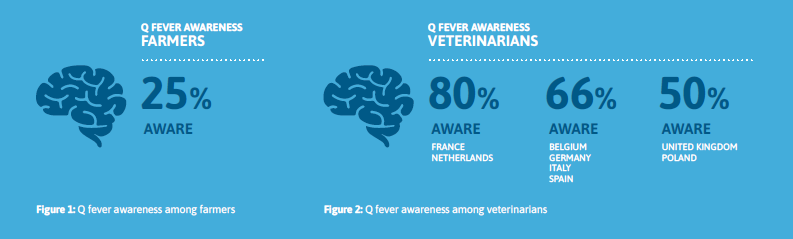
Cattle (571), sheep (198), and goat (177) farmers were interviewed (only goat farmers in the Netherlands, only cattle farmers in Germany, Belgium, and Poland). Approximately 75% of farmers were either unaware of Q fever or only familiar with its name. (Figure 1).
Personal experience with the disease was limited (2–5%) in most countries, but higher in the Netherlands (12%) and France (13%). Around 80% of veterinarians in France and the Netherlands had encountered Q fever cases and demonstrated accurate knowledge. In Belgium, Germany, Italy, and Spain, fewer than two thirds had such experience, and knowledge was poorer; this dropped below 50% in the UK and Poland (Figure 2).
Consequently, vaccination rates remain low: about 1% except in France and the Netherlands. Among human doctors, awareness was generally high, personal experience with cases was frequent in Spain (74%) and France (60%) but rare in Poland and Italy. Human doctors are well aware of the disease. A frequent personal experience with infected patients is reported in Spain (74%) and France (60%). Poland and Italy seem to be the exception, with 70 and 64% of respondents having no experience with Q fever cases.
Conclusions
This is the largest European survey assessing perceptions of Q fever among animal and human health professionals. While national differences exist, farmer awareness is consistently low, and professional knowledge remains heterogenous. These findings underscore the urgent need for coordinated, science-based, harmonized strategies for Q fever management within a One Health framework. The European Q Fever Committee aims to support these efforts.



Share this publication:


