


 Publications


Poster
Comparison of the syringeability of a fixed combination of florfenicol and meloxicam with commonly used florfenicolbased products for the treatment of BRD using a novel highprecision assessment method
Brigitte Trezzani, Damien Achard, Sandrine Lacoste, Marine Letertre, Stephane Trotebas
Publication information
Word Buiatrics Congress 2026
Background and objective
Syringeability is a key parameter for any parental formulation intended for use in cattle and is particularly critical in young calves. Solutions for injections must be easily administered to ensure the welfare of both the animal and the operator-whether a farmer or a veterinarian, especially under challenging winter conditions where increased viscosity can hinder proper delivery.
Materials and Methods
Historically, syringeability of injectable formulations was assessed by applying a constant manual force to the syringe plunger and recording the time required for the product to pass through a needle of predefined gauge. This approach was limited by operator-dependent variability and inconsistent application of force.
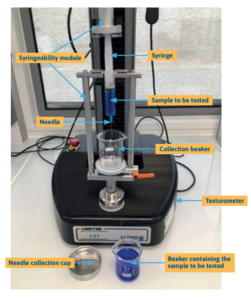
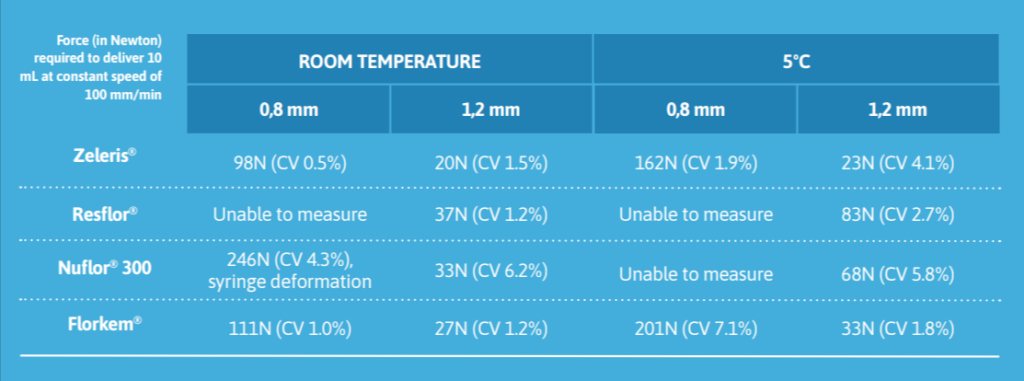
A new syringeability evaluation method was implemented to improve standardization and measurement accuracy. A calibrated texturometer was used to apply a constant and predefined plunger speed of 100 mm/min over a 10 mL displacement. During the test, the instrument continuously measured the force required to extrude the formulation, expressed in Newtons (N). The lower the force is, the easier the injection is. Each formulation was tested six times under identical conditions to assess repeatability. For each set of six measurements, the coefficient of variation (CV) was calculated, expressed as a percentage. A low CV was interpreted as high repeatability of the syringeability profile.Two different temperatures (5ºC and Room Temperature) and two needle gauges (1,2 mm and 0,8 mm) were tested. Four products were compared: Zeleris® (florfenicol 400 g/mL and meloxicam 5 mg/mL, Ceva), Resflor® (florfenicol 300 mg/mL and flunixin meglumine 16.5 mg/mL, MSD), Nuflor®300 (florfenicol 300 mg/mL, MSD), Florkem® (florfenicol 300 mg/mL, Ceva).
Results
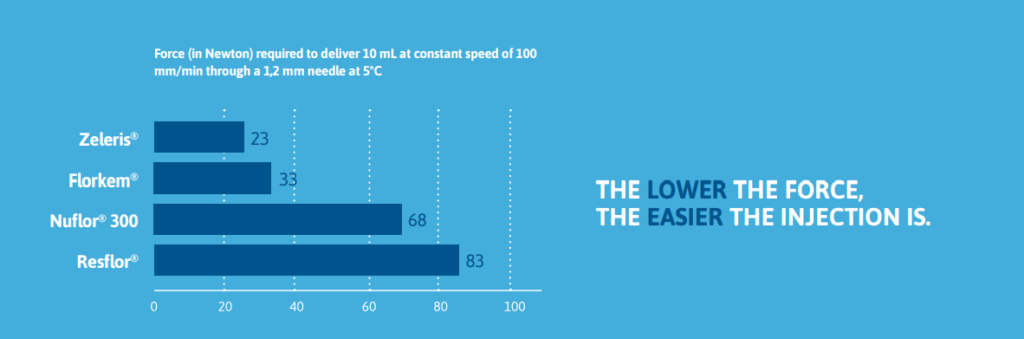
The results of this study clearly demonstrated the high syringeability of Zeleris®: At 5°C, the force needed to inject Zeleris® through a 1,2 mm needle was 23 N. Zeleris® syringeability was better than the other florfenicol-based products both at 5°C (23 N for Zeleris®, 33 N for Florkem®, 68 N for Nuflor® 300 and 83 N for Resflor®) and at room temperature. The superior performances of Zeleris® may be explained by the excipients chosen for its formulation.
Conclusions
- This new method confirmed the high syringeability of Zeleris, combination of florfenicol and meloxicam commonly used in winter season to treat calves suffering from bovine respiratory disease.
- Good syringeability translates to ease, speed, and comfort — for both the farmer and the animal. This directly improves compliance, making it more likely that treatments are performed with the right dose, using the correct technique and route of administration.
Our booklet of abstracts brings together Ceva’s scientific contributions to the World Buiatrics Congress 2026.



Share this publication:


