


 Publications


Poster
The seasonality of Coxiella burnetii induced abortions in small ruminant farms in Greece
I. Gouvias, K. Kola, E. Malissiova, R. Guatteo, G. Valiakos
Publication information
Word Buiatrics Congress 2026
Background and objective
A common cause of abortions and reproductive disorders in sheep and goats is Coxiella burnetii, an obligatory intracellular bacterium that is distributed worldwide on farms of domestic ruminants and is a significant zoonotic agent that causes Q fever in human hosts. The objective of this study was to evaluate the seasonality of Coxiella burnetii-induced abortions in small ruminant samples obtained throughout Greece.
Materials and Methods
Vaginal swab and aborted foetus samples were obtained by veterinary practitioners between January 2024 and December 2025 from ovine and caprine farms throughout the mainland of Greece with reported abortive cases. The samples were obtained from the animals that aborted during the preceding week. Nucleic acid extraction was performed using a commercial spin column kit (INDICAL Bioscience) and an IDEAL™ 32 extraction robot (Innovative Diagnostics). Molecular investigation was performed using a novel commercial kit (ID Gene™ Ruminant Abortion Multiplex HRM, Innovative Diagnostics) according to the manufacturer’s instructions on an MIC qPCR Cycler (Bio Molecular Systems). The kit is a test for the detection of the main pathogens causing abortion in ruminants based on PCR technology coupled with HRM. The results obtained were analyzed with the HRM data interpretation software, DISoft (Innovative Diagnostics).
Results
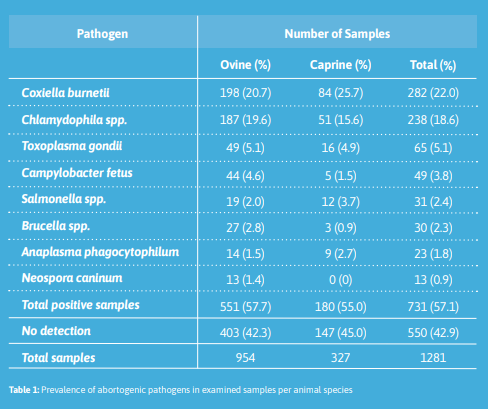
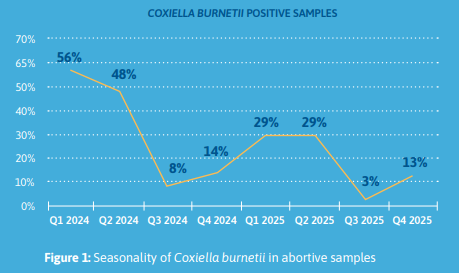
A total of 1281 ovine and caprine samples were examined, and the results indicated a high prevalence of Coxiella burnetii in the investigated group, detected in approximately 22% of the animals (Table 1). The results per trimester indicate a clear seasonality in the positivity rate of the Coxiella burnetii-induced abortions. Particularly, in the first trimester of 2024 83/148 (56.1%) were positive, in the second trimester of 2024 19/40 (47.5%) were positive, in the third trimester of 2024 8/100 (8.0%) were positive, in the fourth trimester of 2024 32/227 (14.1%) were positive. In 2025, the positive PCR samples were 87/300 (29.0%), 17/59 (28.8%), 5/175 (2.8%) and 31/232 (13.4%) in the respective trimesters (Figure 1).
Conclusions
Our findings demonstrate a characteristic seasonal pattern in Coxiella burnetii -induced abortions, peaking during the first half of the year (first and second semester) in two consecutive years. Identifying this seasonality is critical and highlights the need of implementing preventive measures e.g. vaccination and biosecurity protocols in optimal timings (prior to peak transmission periods) in order to reduce economic losses and the zoonotic risk of Q fever to all livestock professionals.
Our booklet of abstracts brings together Ceva’s scientific contributions to the World Buiatrics Congress 2026.


Share this publication:


