


 Publications


Poster
Field evaluation of safety and immune response of an inactivated vaccine against EHD‑8 in cattle
Philippe Gisbert, Pedro Pinho, Sophie Brilland, Jérôme Lafon
Publication information
Word Buiatrics Congress 2026
Background and objective
Epizootic Haemorrhagic Disease serotype 8 (EHD-8) emerged in Southern Europe in 2023, prompting rapid development of an inactivated vaccine (Hepizovac®). This field study aimed to assess in naïve and previously infected heifers:
- The safety of the vaccine
- The humoral immune response induced by vaccination
- The effect of a booster given 6 months or 12 months after primary-vaccination
- The comparison of booster effect triggered by a new single injection or a new full protocol given 12 months after primary-vaccination
Materials and Methods
This study was approved by the Ceva Santé Animale Ethics Committee under number CFAEC-2024-27. The animal phase lasted from December 2024 to March 2026.
The study was conducted in two dairy farms in south-west France previously affected by EHD-8. Eighty Prim’Holstein
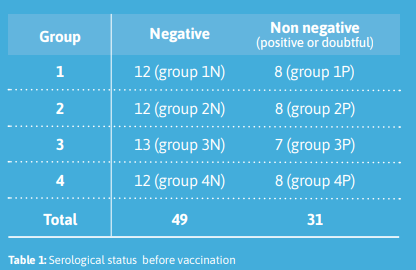
heifers (6–24 months) were enrolled and randomly allocated into four groups (n=20 per group):
- Group 1: Sentinel animals (unvaccinated)
- Group 2: Vaccination with Hepizovac® 4 mL SC at the left neck 2 times at 3 weeks intervals (D0 and D21) and booster 6 months later (D189)
- Group 3: Vaccination with Hepizovac® 4 mL SC at the left neck 2 times at 3 weeks intervals (D0 and D21) and booster 12 months later (D385)
- Group 4: Vaccination with Hepizovac® 4 mL SC at the left neck 2 times at 3 weeks intervals (D0 and D21) and new full vaccination regimen 12 months later (D385 and D406)
Blood samples were collected every 7 to 8 weeks from D–21 to D436 and analysed using a commercial anti-VP7 competitive ELISA (ID Screen® EHDV Competition. IDVet, Grabels, France). Serological dynamics were evaluated separately for animals initially seronegative and those naturally infected before vaccination. Clinical monitoring recorded major side effects, hyperthermia (rectal temperature above 39.5°C) and local reactions
Results
Before vaccination (D–21), 49 animals were seronegative and 31 non-negative (Table 1).
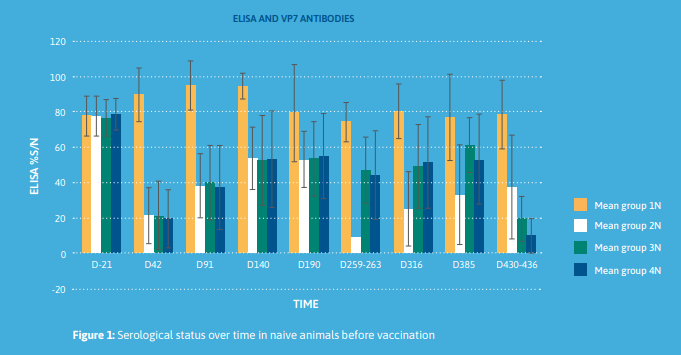
Sentinel animals (Group 1) remained serologically stable, supporting the absence of viral circulation throughout the study.
The vaccine demonstrated good safety, with no major adverse reactions in naïve or previously infected animals. Six transient hyperthermia events occurred after the first dose; none followed the second. Local reactions (local oedema, small nodules <4mm) occurred in 22 heifers after the first injection and 20 after the second.
Negative animals before vaccination (Figure 1):
- Strong immune response after primary vaccination (groups 2N, 3N, 4N groups)
- Antibodies to VP7 decrease over time but remain higher than in the control group.
- Strong booster effect at 6 months (group 2N) and 12 months (groups 3N and 4N)
- No difference in amnestic response at 1 year between 1 single injection (group 3N) and 2 injections (group 4N)
Non-negative animals before vaccination:
- All the animals remained non-negative throughout the study.
- No effect of vaccination on this category of animals.
Conclusions
- The vaccine demonstrates good safety, even in animals already seropositive from prior natural infection.
- The immune response is strong in naive animals.
- A single booster effectively restores humoral immunity, consistent with the involvement of memory T cell.
- At 12 months, a complete revaccination protocol confers no additional benefit compared with a single booster dose.
Our booklet of abstracts brings together Ceva’s scientific contributions to the World Buiatrics Congress 2026.


Share this publication:


