


 Publications


Poster
Ketoprofen as the sole initial treatment for non-severe mastitis: efficacy and antibiotic reduction
Brigitte Trezzani, Ulrike Falkenberg, Nicole Wente, Yanchao Zhang, Stefanie Leimbach, Philippe Gisbert, Franziska Nankemann, Volker Krömker
Publication information
Word Buiatrics Congress 2026
Background and objective
Mastitis in dairy cows is a major health issue traditionally treated with antibiotics. However, growing concerns about antimicrobial resistance have prompted exploration of alternative therapies. This study aimed to evaluate the efficacy of a non-steroidal anti-inflammatory drug (NSAID)-based treatment concept using ketoprofen (KE) compared to conventional intramammary antibiotic therapy (AB) for mild and moderate clinical mastitis (CM).
The primary objective was to assess clinical cure at day 5, bacteriological cure at days 14 and 21, recurrence within 60 days, and new infection risk, while highlighting the potential reduction in antibiotic usage.
Materials and Methods
A randomized, multi-herd, non-inferiority trial was conducted on three dairy farms in Northern Germany between August 2022 and November 2023. A total of 222 lactating Holstein-Friesian cows with mild or moderate CM were enrolled. Animals were randomly assigned to two groups: AB group received local intramammary antibiotics (cefalexin and kanamycin, Ubrolexin® Boehringer Ingelheim) 2 injections 24 hours apart, while KE group received systemic ketoprofen (Romefen® PR 10%/Ketofen® 10%, Ceva Santé Animale) for three days, with antibiotics added only if no improvement was observed by day 3. Clinical examinations were performed every 12 hours for six days, and milk samples were collected for microbiological analysis.
Results
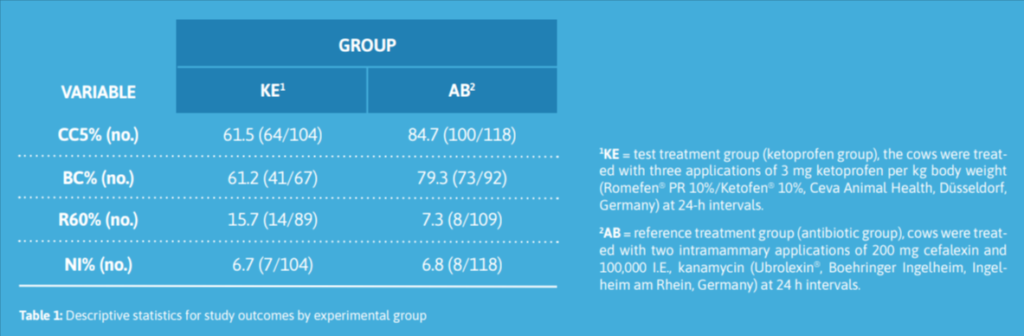
Of 222 cases, 118 were treated with antibiotics (AB) and 104 with ketoprofen (KE). Clinical cure at day 5 was 91.2% for AB group and 67.8% for KE group (P < 0.001). Bacteriological cure rates were 78.6% for AB group and 59.6% for KE group (P = 0.026).
Recurrence within 60 days was 5.8% for AB group and 14.0% for KE group (P = 0.046), while new infection risk did not differ significantly between groups.
Fourteen cows in the KE group required subsequent antibiotic therapy. The KE group achieved an 86% reduction in antibiotic doses compared to AB (P < 0.001). Because of the absence of need to discard milk after ketoprofen treatment, there was 35.9% less milk wasted in the KE group compared to the AB group (milk has been commercialized again as soon as its appearance returned to normal).
Conclusions
The NSAID-based treatment concept substantially reduced antibiotic usage and waste milk, contributing to antimicrobial stewardship and sustainability. However, lower clinical and bacteriological cure rates in the KE group indicate that sole NSAID therapy cannot replace antibiotics in all mastitis cases. Nevertheless, this approach represents a promising step toward reducing antibiotic consumption in dairy farming without compromising animal welfare.
Our booklet of abstracts brings together Ceva’s scientific contributions to the World Buiatrics Congress 2026.



Share this publication:


