


 Publications


Poster
BoviSensor: a new user-friendly digital tool to assess pain in cattle
B. Trezzani, M. Morin, P. Gisbert, S. Trotebas, G. Touzot Jourde, R. Guatteo
Publication information
Word Buiatrics Congress 2026
Background and objective
Effective detection and management of pain are fundamental for improving cattle welfare; however, progress is still equired to enhance awareness, promote standardized assessment, and ensure the systematic implementation of analgesic strategies. All painful conditions warrant attention, even in the absence of consequences on productivity in adult animals. Consideration must also be given to calves, which experience several painful conditions, yet are often monitored less frequently and exhibit more subtle or nonspecific pain behaviors. Until recently, pain assessment tools for cattle were limited, with most existing frameworks addressing only a single pathology (e.g., lameness or postsurgical pain).
Materials and Methods
Under the leadership of Oniris (National Veterinary School of Nantes, France), a panel of veterinary experts employed a structured Delphi method to develop a series of condition-specific, user-friendly pain assessment grids applicable to several common clinical conditions in both adult cattle and young calves. The expert panel comprised twelve specialists from seven different countries, representing both academic institutions and field-based veterinary practices.
Results
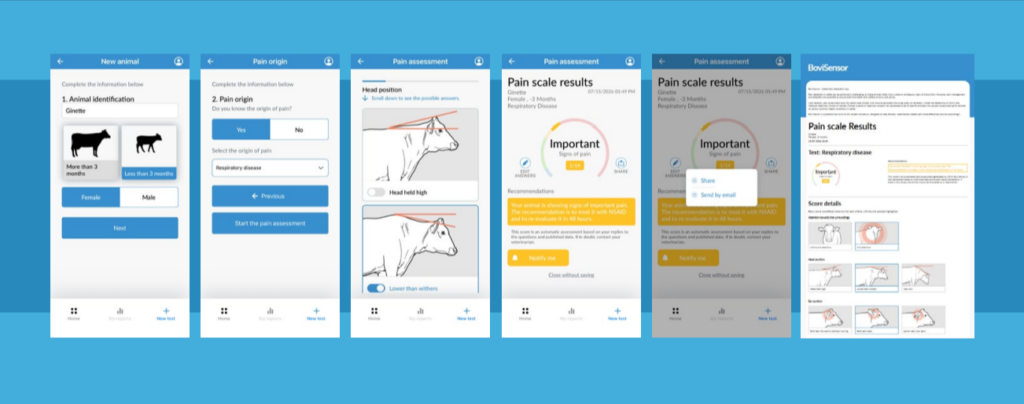
This consensus-based process led to the development of a dedicated digital tool: BoviSensor, enabling veterinarians and farmers to generate a standardized pain score for each animal and clinical condition. The tool follows a structured workflow comprising:
1. Identification of the animal’s age category and sex;
2. Selection of the suspected source of pain, when known (when the source of pain is unknown, the tool can still be used based on non-specific signs of pain);
3. Recording of the illustrated postural and behavioral indicators observed. Based on these inputs, the tool calculates score that categorizes the level of pain and subsequently recommends either analgesic intervention or a scheduled re-evaluation.

The generated report, which includes all recorded clinical signs, can be saved and shared for documentation or follow-up.
When analgesic treatment is administered, a re-evaluation is encouraged; the expected reduction in the pain score provides educational feedback for the user, reinforcing the effectiveness of appropriate pain management.
Conclusions
BoviSensor is a practical decision‑support tool designed to assist farmers and veterinarians in improving the detection of pain and implementing appropriate management strategies. Enhancing cattle welfare will require substantial changes in current practices, particularly regarding pain management across a wide range of situations—from calving and dehorning to infectious and traumatic conditions. Effective analgesia represents a worthwhile investment. The routine use of BoviSensor as a standardized pain‑scoring system constitutes an essential first step toward increasing awareness at farm level. A trial is currently underway to rigorously evaluate the tool’s sensitivity, specificity, and repeatability under field conditions.
Our booklet of abstracts brings together Ceva’s scientific contributions to the World Buiatrics Congress 2026.



Share this publication:


